

Spring-Return vs. Double-Acting: STARD GEARS as a Leading Scotch Yoke Actuator Manufacturer from China
Spring-Return and Double-Acting Answer Different Failure Requirements
The YP Series strictly defines Spring-Return and Double-Acting as two separate configurations, with the former dedicated to fail-safe operation logic and the latter serving projects characterized by non-fail-safe requirements. The selection process must begin by determining exactly what action the valve must take when the process loses power or pneumatic control, rather than prematurely comparing actuator dimensions, pricing, or single catalog torque values.
By providing both configurations within the identical YP product family, engineering teams are empowered to select the actuation method based entirely on the system’s failure requirements. This approach maintains complete consistency across the product platform and the fundamental logic of quarter-turn applications. The core distinction between Spring-Return and Double-Acting models lies in their specific failure behaviors rather than performance superiority, requiring correct selection to first define the necessary safety position and control reaction of the fluid process.
Spring-Return Selection Starts with Spring Torque at Worst-Case Differential Pressure
Projects utilizing the Spring-Return configuration must independently verify the spring torque, as it is a critical error to assume the pneumatic opening torque equates to the available closing or opening torque upon loss of air supply. In a spring-return actuator, the mechanical torque generated by the spring is not identical to the pneumatic opening torque. Therefore, fail-close or fail-open designs require absolute verification that the spring can successfully complete the targeted action under the worst-case differential pressure conditions.
Purchasers must demand torque data from the valve manufacturer calculated at the maximum differential pressure, and then compare that data against the output of the selected spring set to verify the actual safety action requirements. This strict verification process avoids the common mistake of judging fail-safe capabilities based solely on the pneumatic peak output of the actuator. The reliability of a fail-safe system depends heavily on independent spring torque verification, prohibiting the use of pneumatic output as a substitute for validating physical safety actions.
Pre-Compressed Spring Architecture Reduces Disassembly Risk
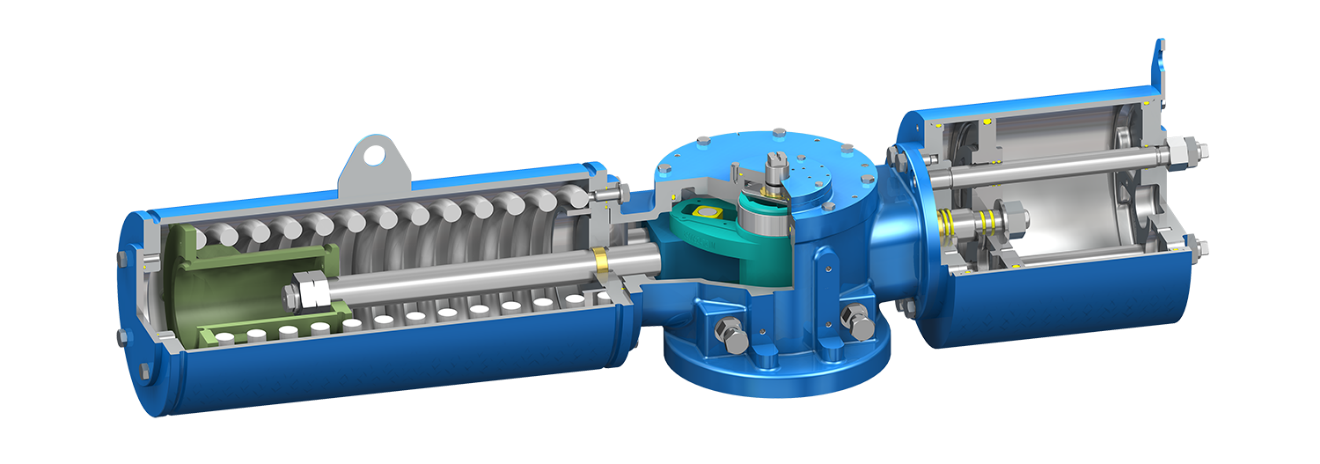
The YP Spring-Return design incorporates a pre-compressed spring module and separates the spring load from the actuator end cap, significantly mitigating the risks associated with the accidental release of the spring during disassembly. Because the entire spring module undergoes pre-compression prior to final assembly, maintenance personnel interact with a controlled, enclosed module rather than a free-compressing spring restrained directly by the end cover. This structural shift fundamentally alters the mechanical risk pathways encountered during inspection and teardown.
The spring does not exert continuous pressure on the actuator end cap, which means the removal of the end cover does not inherently release the main spring load. This provides the Spring-Return configuration with an inherent structural safety design directly relevant to maintenance operations. The pre-compressed spring architecture of the YP Series successfully extends the safety profile of the fail-safe actuator into the maintenance phase, reducing the hazards associated with direct spring energy release.
Double-Acting Fits Projects Without a Spring-Driven Fail-Safe Requirement
When a project explicitly does not require a spring-driven fail-safe action, the Double-Acting model serves as the non-fail-safe configuration within the YP family, though the ultimate failure behavior must still be defined by the pneumatic and control system architecture. The Double-Acting configuration should never be treated as a universal substitute for the Spring-Return model; its application is strictly limited to projects where the mechanical spring is not required to force the valve into a predefined safety position upon air loss.
Factors such as the air supply, solenoid and control logic, air reservoirs, or other auxiliary systems heavily influence the final failure behavior of the Double-Acting setup. Consequently, engineering specifications must explicitly define how the valve should respond during electrical, pneumatic, or control signal anomalies, rather than assuming a safety position based merely on the “Double-Acting” nomenclature. The control system architecture must assume the responsibility for defining the failure behavior when mechanical springs are omitted.
Pressure, Temperature, and Protection Still Govern Both Configurations
Regardless of whether the Spring-Return or Double-Acting configuration is chosen, the YP Series must be carefully matched to the project within the published air pressure, temperature, and protection parameters. The operating air pressure for the YP Series spans 3 to 7 barg, meaning air supply stability and available site pressure must be factored into the actuator output verification, as a nominal configuration type cannot compensate for inadequate pneumatic supply.
The equipment is available in a standard temperature range of -20°C to 80°C, a high-temperature version from -20°C to 150°C, and a low-temperature variant spanning -40°C to 80°C, all while maintaining an IP67 protection level. These environmental parameters must be cross-referenced with the ambient conditions on-site during the configuration confirmation phase. Configuration names merely serve as a starting point; both actuator types must undergo rigorous project-level adaptation concerning air supply, temperature, and environmental defense.
A Configuration Checklist Keeps the Comparison Engineering-Led
A finalized Request for Quotation must simultaneously lock in the fail position, spring torque, available air pressure, valve torque, duty cycle, temperature, and control architecture to prevent the Spring-Return versus Double-Acting comparison from being reduced to a simple product preference. STARD GEARS can use these project inputs to confirm the appropriate YP configuration for the target valve and operating conditions. Procurement teams should submit complete operating data so actuator selection remains tied to the actual engineering requirement.
When fail-safe logic, worst-case differential pressure, and environmental boundaries are clearly defined, the resulting comparison easily translates into an auditable technical specification. Procurement teams can use these defined parameters to confidently establish their engineering baseline. For definitive project confirmation regarding Spring-Return or Double-Acting configurations, engineers and buyers should visit https://www.stard-gears.com/ to finalize their technical documentation and sourcing execution.
Suzhou SIP Stard Automation CO.,LTD.
STARD GEARS
email us here
Visit us on social media:
LinkedIn
YouTube
Legal Disclaimer:
EIN Presswire provides this news content "as is" without warranty of any kind. We do not accept any responsibility or liability for the accuracy, content, images, videos, licenses, completeness, legality, or reliability of the information contained in this article. If you have any complaints or copyright issues related to this article, kindly contact the author above.
