

Extreme Heat Is Becoming an Operating Constraint: SHIRO & Co. Maps the Emerging Market for Usable Human Time
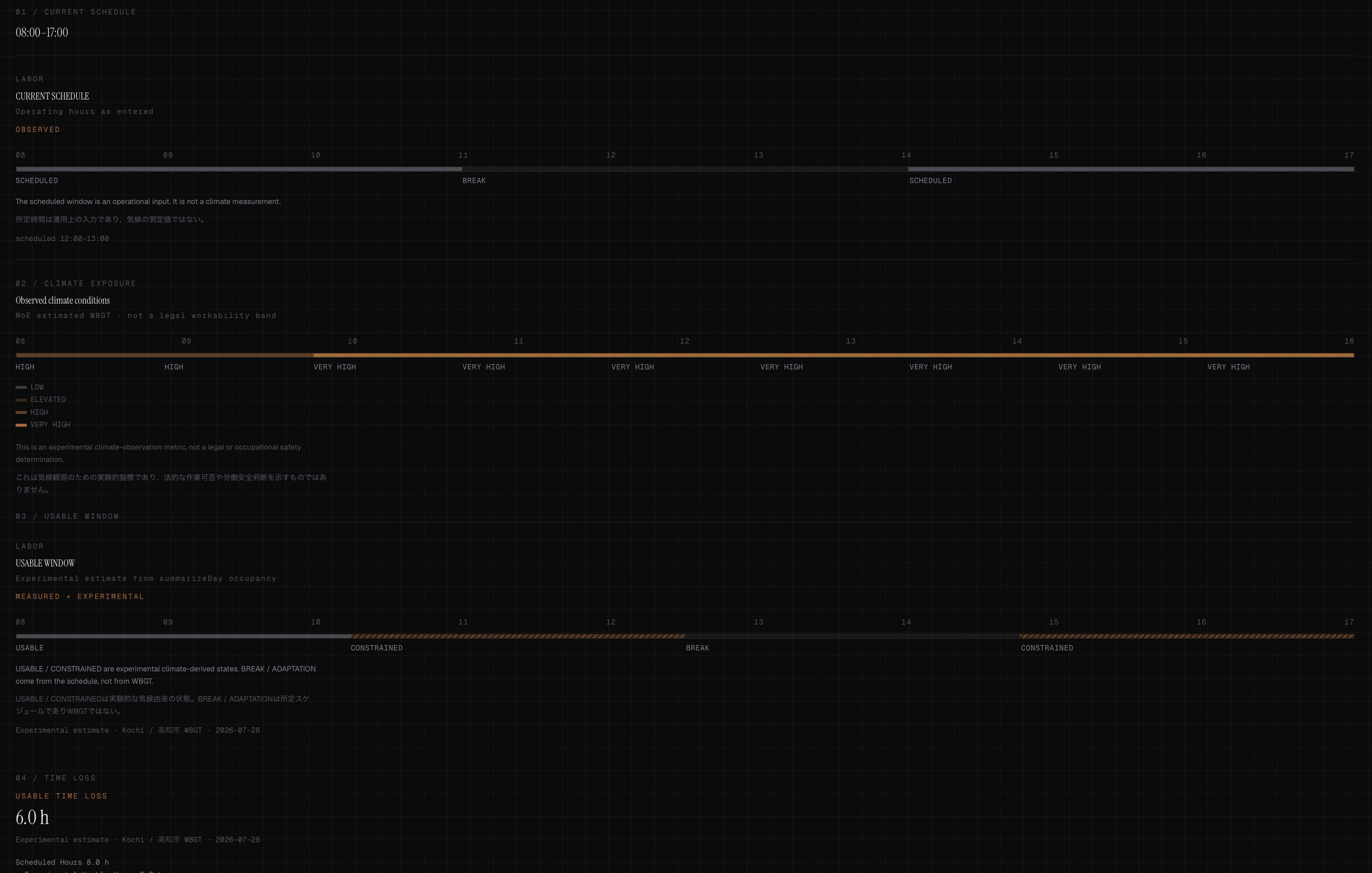
Experimental Climate Usable Time Assessment comparing Kochi and Tokyo across a 53-day observation period.
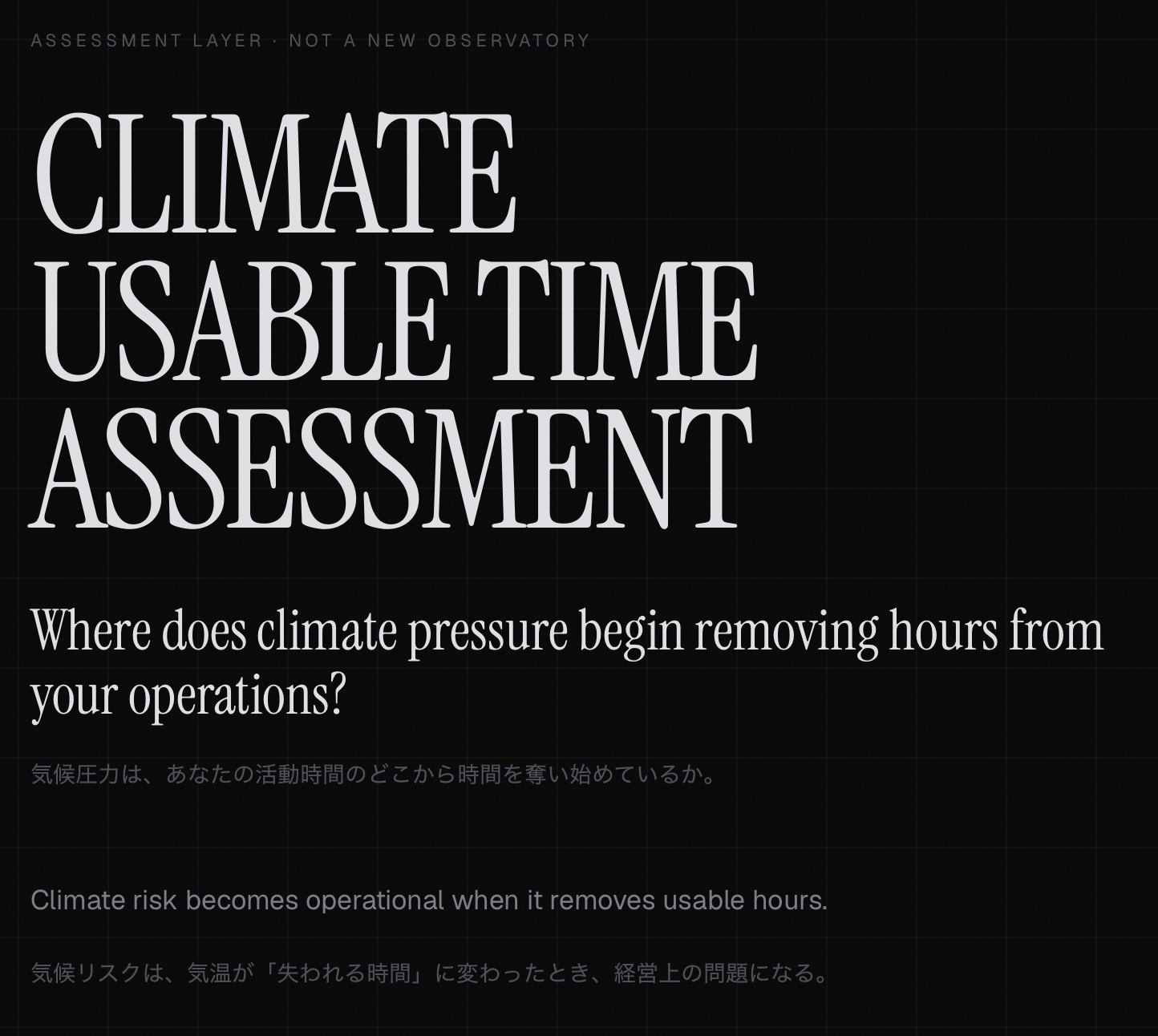
Climate Temporal Compression – Climate Usable Time Assessment
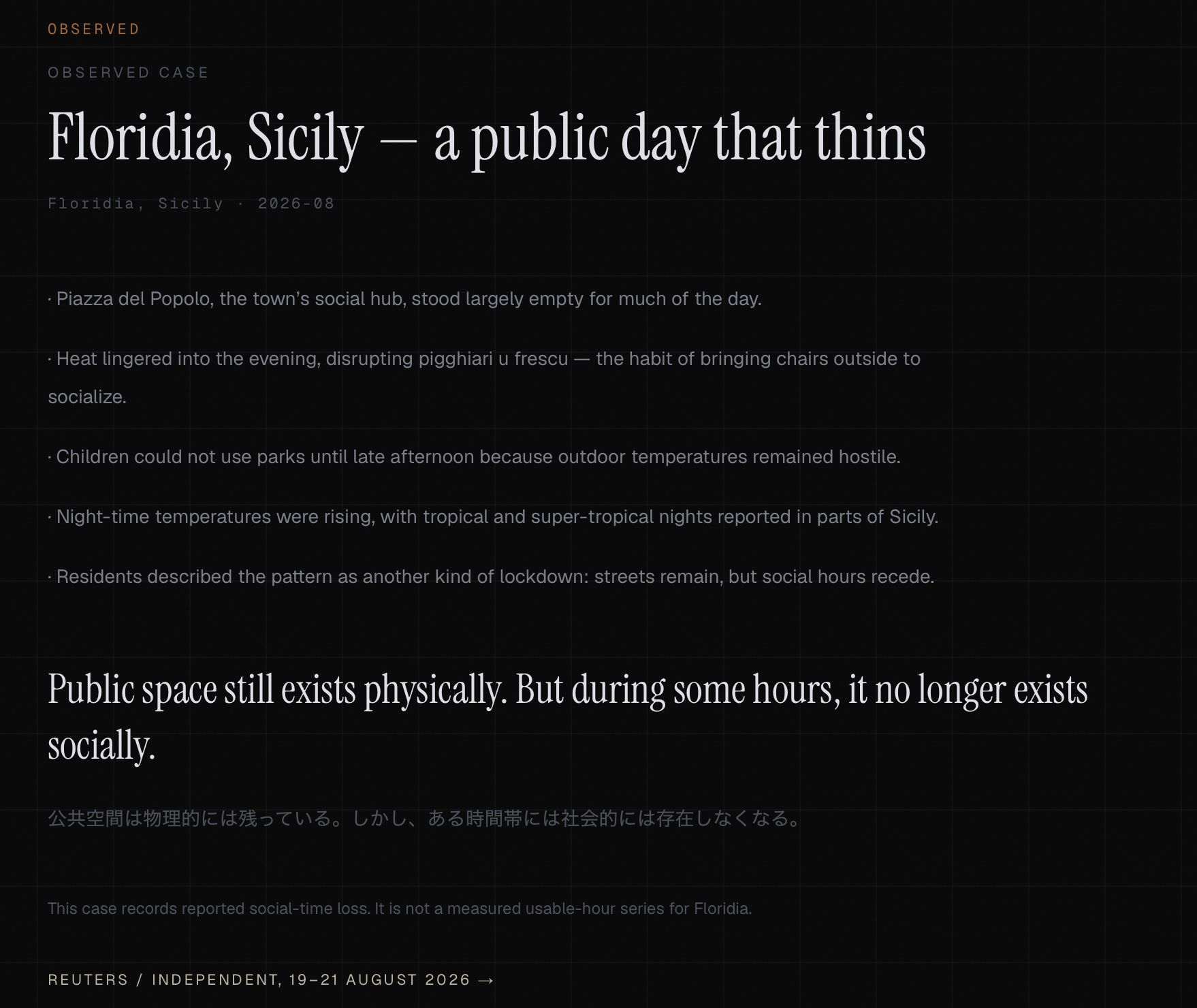
Observed case from Floridia, Sicily: extreme heat thins public life by pushing social activity out of the hottest hours, illustrating climate-driven loss of usable social time.
An observation generated through the Kosuke Protocol reframes extreme heat as lost operational time, using Kochi and Tokyo as a measured case.
TOKYO, OTA-KU, JAPAN, September 3, 2026 /EINPresswire.com/ -- SHIRO & Co. has published one of the first applied observations generated through the Kosuke Protocol, its system for turning observed change into structured business and societal questions.
The resulting observation, "Climate Temporal Compression", reframes extreme heat not only as rising temperature, but as lost usable time. It is now being tested through SHIRO & Co.’s Climate Observatory using an experimental comparison of Kochi and Tokyo.
The framework, called "Climate Temporal Compression", starts from a simple premise:
Climate change changes temperature.
But economies operate in time.
As extreme heat reduces the hours in which outdoor work, public activity, recovery and biological production can occur, climate risk may increasingly appear as a scarcity of usable time.
SHIRO & Co. calls this emerging condition Temporal Scarcity.
Explore the press demonstration of Climate Temporal Compression, including the Kochi–Tokyo comparison and experimental usable-time framework:
[PRESS DEMO URL:https://www.shiroand.io/climate-temporal-compression]
FROM CLIMATE EXPOSURE TO OPERATING CAPACITY
Most organizations measure operational capacity through familiar inputs such as workforce, equipment, capital and physical assets.
Climate Observatory introduces another potential variable:
How many of the scheduled hours are actually usable under prevailing climatic conditions?
The Observatory defines Usable Time as the amount of time during which a specific human, biological or economic activity can be performed safely and realistically under prevailing climate conditions.
Its first measured prototype focuses on outdoor labor.
Using hourly estimated WBGT data published by Japan’s Ministry of the Environment, SHIRO & Co. applied the same experimental method to Kochi and Tokyo across 53 complete days between July 1 and August 22, 2026.
The comparison does not rank the cities by temperature. Instead, it examines how the same nominal workday can encounter different patterns of usable time.
ONE NATIONAL CLOCK, DIFFERENT LOCAL OPERATING CAPACITY
Across the 53-day observation period, the experimental model found:
Kochi:
* Median usable-time loss: 1.0 hour
* Maximum usable-time loss: 7.0 hours
* Days with very-high heat constraint: 28
* Days with zero modeled loss: 25
Tokyo:
* Median usable-time loss: 0.0 hours
* Maximum usable-time loss: 7.0 hours
* Days with very-high heat constraint: 19
* Days with zero modeled loss: 34
On July 28, the contrast was particularly visible.
The experimental estimate showed six hours of usable-time loss during the standard outdoor workday in Kochi, while the same model showed zero hours of loss in Tokyo.
The scheduled workday had not changed.
The usable workday had.
SHIRO & Co. describes this emerging difference as Temporal Geography: the idea that operational time itself acquires geography as climate exposure varies between locations.
CLIMATE RISK MAY HIT CAPACITY BEFORE IT HITS ASSETS
Traditional climate-risk discussions often focus on damaged assets, disrupted supply chains or physical infrastructure.
Climate Observatory examines an earlier possibility: climate exposure may begin creating regional differences in execution capacity before physical assets themselves are damaged.
For organizations operating across multiple regions, this could potentially affect project scheduling, workforce allocation, regional capacity planning, automation strategy, remote operations, cooling infrastructure and the economics of maintaining human presence.
This also changes how automation may eventually be evaluated.
The relevant comparison may no longer be only:
Robot cost versus wages.
It may increasingly become:
Automation cost versus the total cost of maintaining safe human presence.
AN OBSERVED ADAPTATION IN JAPANESE PUBLIC WORKS
Kochi Prefecture has introduced a Cool Work Time guideline for construction work that is primarily performed outdoors.
During the summer period, the guideline calls in principle for work to stop between 11:00 and 14:00, with an operating example of 08:00–11:00 and 14:00–17:00.
The guideline recognizes approximately two hours of shortened daily work and allows construction schedules to be extended accordingly.
SHIRO & Co. treats this policy as an observed adaptation and keeps it separate from its experimental climate-derived usable-time estimate.
CLIMATE ADAPTATION MAY BECOME A SCHEDULING PROBLEM
When daytime becomes too hot, activity can move earlier, later or into the night.
But cooler hours are not an unlimited resource.
Outdoor labor may need them. Public life may need them. Human bodies need them for recovery. Agriculture may increasingly depend on narrower viable biological windows.
Climate Observatory calls this potential competition for viable hours Time Competition.
In that scenario, climate adaptation moves beyond cooling equipment and physical infrastructure. It becomes a problem of allocating scarce viable time.
SHIRO & Co. sees potential demand forming around systems that help organizations understand, allocate and protect those hours, including scheduling, workforce orchestration, automation, remote operation and climate-responsive infrastructure.
The Observatory does not claim that these markets have already formed. It is monitoring the conditions under which they could emerge.
TIME AS INFRASTRUCTURE
The broader thesis behind Climate Temporal Compression is that access to climatically viable hours may become an operational resource in its own right.
Clock time is standardized.
Usable time is local.
If this distinction becomes economically material, companies operating across multiple regions may need to understand not only where their assets and workers are located, but when each location remains operationally usable.
SHIRO & Co. calls this emerging perspective Time as Infrastructure.
The Climate Usable Time Assessment is an experimental climate-observation tool. It does not determine legal workability, occupational safety compliance or individual heat risk.
This page presents a press demonstration of Climate Temporal Compression. For production use, enterprise assessment, or implementation inquiries, please contact SHIRO & Co.
ABOUT SHIRO & CO.
SHIRO & Co. observes structural change across technology, society, markets, climate and human behavior.
Its Kosuke Protocol connects fragments and signals to observations, structural patterns, simulations and company-specific opportunities, with the aim of identifying emerging systems before they become established categories.
KOSUKEMAIKO SHIRAKO
SHIRO & Co.
+81 80-1269-5473
email us here
Visit us on social media:
LinkedIn
Legal Disclaimer:
EIN Presswire provides this news content "as is" without warranty of any kind. We do not accept any responsibility or liability for the accuracy, content, images, videos, licenses, completeness, legality, or reliability of the information contained in this article. If you have any complaints or copyright issues related to this article, kindly contact the author above.
