

Perimeter Security Market Surges from USD 84.9 Billion to USD 229.2 Billion at 10.5% CAGR
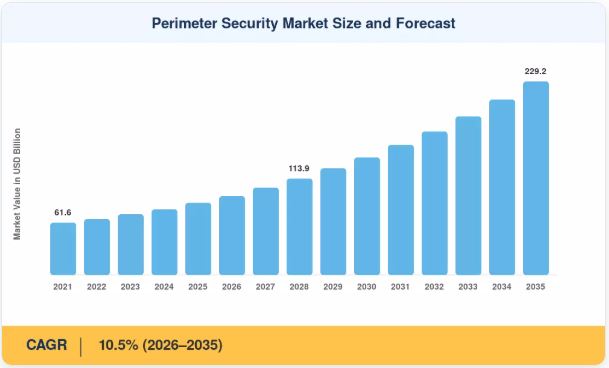
Perimeter Security Market Size
Perimeter Security Market Size, Share and Research Report By Technology (Physical Security Management, Video Surveillance System, Access Control System
Perimeter Security Market: Accelerating as physical threats, critical infrastructure protection needs, and advanced video surveillance systems drive demand for multi-layered boundary defense.”
PARIS, PARIS, FRANCE, September 4, 2026 /EINPresswire.com/ -- The Global Perimeter Security market reached USD 84.9 billion in 2025 and opens the forecast window at USD 93.3 billion in 2026, climbing to USD 229.2 billion by 2035 at a 10.5% CAGR. Two catalysts anchor that trajectory. The EU's Critical Entities Resilience Directive, transposed into national law across member states through 2024-2026, forces operators of energy, transport and water assets to demonstrate physical resilience rather than merely document it. In parallel, U.S. hyperscale data-centre construction, more than USD 60 billion committed in 2025 alone, has created a buyer class that treats fence-line breaches as revenue events, not compliance footnotes. — Market Research Future (MRFR)
The market's 10.5% CAGR reflects the convergence of critical-infrastructure resilience mandates (2.4% impact), data-centre and hyperscale campus buildout (2.1%), low-cost aerial incursion threat (1.8%), and AI-based video and sensor analytics (1.7%) accelerating across the world's largest regulatory-resilience and digital-infrastructure economies simultaneously.
The Perimeter Security Market is expanding as organizations increasingly prioritize the protection of facilities, assets, people, and critical infrastructure from unauthorized access and physical threats. Perimeter security solutions combine technologies such as surveillance cameras, intrusion detection systems, radar, sensors, access control, barriers, and intelligent monitoring platforms to establish protective boundaries around sensitive locations. Rising security concerns, infrastructure modernization, and the adoption of advanced monitoring technologies are supporting market growth across commercial, industrial, government, transportation, and defense environments.
Get Full PDF Sample Copy of Report: (Including Full TOC, List of Tables & Figures, Chart) @
https://www.marketresearchfuture.com/sample_request/12522
The growing importance of Airport Perimeter Security is contributing significantly to demand for advanced perimeter protection technologies. Airports cover large and complex areas that require continuous monitoring of runways, restricted zones, terminals, access roads, and surrounding boundaries. Traditional fences and physical barriers are increasingly being complemented by video analytics, thermal cameras, radar, motion sensors, and automated detection systems. The need to identify unauthorized activity quickly while maintaining operational efficiency is encouraging airports to adopt integrated and intelligent perimeter security platforms.
The adoption of Security as a Service is also transforming the perimeter protection landscape by providing organizations with flexible, technology-driven security capabilities without requiring extensive investments in on-premises infrastructure. Cloud-based monitoring, remote surveillance, managed security services, analytics, and centralized control can help organizations improve visibility across multiple locations. This model is particularly attractive to businesses seeking scalable security solutions that can adapt to changing operational requirements while reducing the burden of maintaining complex security infrastructure.
➤ What Does the Future Hold for the Perimeter Security Market?
Critical-infrastructure resilience mandates contribute approximately 2.4 percentage points to the perimeter security market's CAGR the single highest driver impact. Member states are required under Europe's Critical Entities Resilience Directive to identify critical entities in eleven sectors and to carry out risk assessments with documented physical countermeasures. About 1,600 operators are impacted by Germany's KRITIS-Dachgesetz deployment alone.
Transmission substations in the US are required to implement physical security plans with unannounced audit exposure under TSA Security Directive Pipeline-2021-01 series and NERC CIP-014. Due to the recurring nature of audit cycles, compliance-driven procurement currently accounts for an estimated 31% of first-time buyer spending in the market.
Data-centre and hyperscale campus buildout contributes approximately 2.1 percentage points to the CAGR, establishing digital-infrastructure capital as a primary structural driver. Security fit-out usually accounts for 0.8-1.4% of shell-and-core budgets, with global data-centre capital investment exceeding USD 400 billion in 2025, meaning a 100 MW campus carries a perimeter scope of USD 6-14 million. Because a single unauthorized access can cancel uptime warranties, operators demand tiered detection, and Uptime Institute survey data attributes 8% of reported disruptions to physical access or intrusion events.
Low-cost aerial incursion threat adds a further 1.8% as sightings of unauthorised small aircraft near airports and energy sites rose sharply across 2023-2025, with UK and U.S. authorities logging four-figure annual incident counts that ground-referenced fences cannot detect, pushing counter-drone detection from a specialist defence line item into mainstream commercial tenders. AI-based video and sensor analytics contribute a further 1.7% as modern classifier models cut nuisance alarms by 60-85% in vendor-validated deployments, letting one operator supervise five to eight sites instead of one, a labour-arbitrage economics shift that unlocks budget approval more than sensor performance alone.
The next phase of the market's evolution centers on autonomous detection and response, as by 2030 a majority of large-site deployments will run classification at the edge with human review reserved for escalations; vendor field data already shows automated triage handling above 90% of events without operator involvement, redefining pricing away from device counts toward verified-event volumes.
Platform economics and switching costs are becoming the retention layer, as once an operator standardises alarm workflows, evidence retention and audit exports on one platform, hardware becomes interchangeable but the platform does not, with gross-margin mix expected to shift toward software as attach rates climb past 60% on new installations. The energy and digital infrastructure supercycle gives the market a demand floor tied to capital rather than security sentiment, as the IEA projects global electricity investment sustaining historic highs through the decade, with grid capital alone approaching USD 600 billion annually and every new substation, converter station, and data-centre campus arriving with a mandatory perimeter scope.
Sustainability and total cost reporting are also reshaping procurement, as scorecards increasingly weight embodied carbon and site power draw, and suppliers publishing verified lifecycle data for solar-powered detection pods are beginning to win tie-breaks on public tenders in Europe.
Get access to the full description of the report @
https://www.marketresearchfuture.com/reports/perimeter-security-market-12522
➤ Who Are the Key Players in the Perimeter Security Market?
MRFR identifies the following key participants with estimated revenue share ranges:
Honeywell International (~7–10% share) - an enterprise-scale conglomerate cross-selling into building systems, providing integrated command platforms, access control, and intrusion detection, having launched an updated unified command platform in March 2024 consolidating video, access and intrusion alarm workflows for operators running four or more point systems.
Johnson Controls (~6–9% share) - a leader in commercial and institutional retrofit, providing video, access, and unified security management, anchoring much of the industry's brownfield estate consolidation.
Robert Bosch / Bosch Security (~5–8% share) - an engineering-depth provider with a strong European installed base, providing cameras, analytics, and intrusion panels, serving customers requiring deep technical integration across mixed-vintage estates.
Axis Communications (~4–7% share) - the open-standards leadership specialist with a broad partner ecosystem, providing network cameras, radar, and edge analytics, having expanded its radar portfolio with wider-area units in September 2023 aimed at fence-line and open-ground detection, signalling mainstream adoption of radar-video fusion.
Hikvision (~4–7% share) - a volume price leader restricted in some markets, providing cameras, thermal, and integrated platforms, serving cost-sensitive deployments across Asia-Pacific and emerging markets.
Teledyne FLIR (~3–6% share) - the defence and critical-asset detection specialist, providing thermal imaging and ground radar, having expanded thermal and ground-radar bundles for data-centre campuses in May 2025, responding to hyperscale operators standardising perimeter specifications across multiple sites.
Dahua Technology (~3–6% share) - an emerging-market channel strength provider, providing video, thermal, and perimeter analytics, serving price-sensitive volume programmes across Asia-Pacific and Latin America.
Schneider Electric (~2–4% share) - a cyber-physical convergence positioning specialist, providing access control integrated with facility systems, serving customers requiring unified OT and physical-security governance.
Senstar Technologies (~2–4% share) - the pure-play detection specialist, providing fence sensors, buried cable, and video fusion, having introduced integrated fence-sensor and video-analytics packages in November 2024 for utility and correctional applications, targeting nuisance-alarm reduction as the primary sales metric.
Thales Group (~2–4% share) - a systems-of-systems prime contractor, providing border, airport, and critical-site programmes, positioned to serve large government and defence procurement requiring full-scope integration.
Strategic competition in the perimeter security market is increasingly defined by verified nuisance-alarm reduction and audit-ready evidence export rather than sensor count or camera resolution alone, with high upfront capital and civil works cost cited as a top structural headwind, contributing an estimated -1.6% drag on CAGR as installed costs for fully instrumented ground-based systems range from USD 180 to 420 per linear meter, meaning a 12-kilometer refinery boundary can cost USD 2-5 million before software, alongside integration complexity with legacy estates where discovery and interfacing account for 25-40% of retrofit project hours, a skilled installer and operator shortage estimated in the tens of thousands across North America and Europe, privacy and data-protection constraints in Europe, and fragmented standards and interoperability gaps.
➤ What Are the Emerging Trends in the Perimeter Security Market?
Several transformational trends are redefining the perimeter security market's evolution through 2035:
Outcome-Based Managed Services: Shifting from box sales to monitored service contracts converts one-time capex into recurring revenue with 15-25 percentage points higher gross margin, and buyers accept it because they inherit staffed monitoring without hiring, making managed offerings the fastest-growing service line.
Emerging-Market Border and Port Programmes: India's port modernisation pipeline and ASEAN customs upgrades represent multi-billion-dollar addressable scope where perimeter scope is bundled into concession agreements, and suppliers with local manufacturing content qualify for procurement preference, making joint ventures the practical entry route.
Sensor Data Monetisation: Detection platforms already generate classified event streams, and packaging anonymised incident telemetry into risk-scoring feeds for insurers and reinsurers opens a second revenue line, with carriers having begun offering premium credits against verified detection performance.
Cyber-Physical Convergence Platforms: IEC 62443 and NIS2 push operators toward unified governance of OT and physical controls, and vendors that certify their edge devices and present a single audit evidence pack win consolidation deals from customers currently juggling four or five point tools.
Retrofit of Utility Substations: Grid operators face substation hardening requirements with thousands of eligible sites and limited installed detection, and modular, solar-powered radar-and-camera pods sidestep the trenching cost problem, opening a segment previously blocked by civil works economics.
Buy Full Research Report:
https://www.marketresearchfuture.com/checkout?currency=one_user-USD&report_id=12522
➤ How Is the Perimeter Security Market Segmented?
The perimeter security market report provides a comprehensive segmentation framework:
By System: Video Surveillance (42.0% share, 2025), Access Control (USD 20.8 billion, 2025), Perimeter Intrusion Detection Systems (10.7% CAGR), Alarms and Notification Systems (9.2% share, 2025), Others — Lighting, Barriers, Deterrence (USD 3.8 billion, 2025)
By Service: System Integration and Consulting (USD 39.7 billion, 2025), Managed Security Services (10.9% CAGR), Risk Assessment and Analysis (12.4% share, 2025), Maintenance and Support (USD 14.2 billion, 2025)
By End-User: Military and Defence (26.2% share, 2025), Commercial (11.3% CAGR), Transportation (USD 13.6 billion, 2025), Industrial (15.1% share, 2025), Government (USD 9.4 billion, 2025), Residential (4.3% share, 2025)
By Deployment Type: Ground-Based (56.8% share, 2025), Barrier-Mounted (USD 36.7 billion, 2025)
By Region: North America (29.8% share, 2025), Europe (USD 22.4 billion, 2025), Asia-Pacific (12.3% CAGR), South America (6.6% share, 2025), Middle East & Africa (USD 10.4 billion, 2025)
➤ What Are the Regional Insights from the Perimeter Security Market?
Regional performance in the perimeter security market diverges sharply on regulatory intensity rather than GDP, with mandate-heavy geographies buying earlier and refreshing faster.
North America holds 29.8% share in 2025, with the United States commanding 72.4% of regional share through NERC CIP-014 and TSA directives, supported by strong infrastructure investment and robust demand across hyperscale and industrial applications. Canada contributed USD 3.2 billion through pipeline and port asset protection, and Mexico is the fastest-growing country in the region at a 9.8% CAGR through nearshoring industrial park buildout.
European buying in the perimeter security market, which held USD 22.4 billion in 2025, is audit-driven.
Asia-Pacific is the growth engine of the perimeter security market because demand is additive rather than replacement-led, posting the fastest regional CAGR at 12.3%. China commands 33.4% of regional share through industrial and transport network scale, India is posting a 14.1% CAGR within the region as its Sagarmala port programme and associated freight corridors created greenfield perimeters where none existed, Japan contributed USD 3.4 billion through ageing infrastructure replacement, South Korea holds 9.6% of regional share through semiconductor fab site security, ASEAN is growing at a 12.8% CAGR through data-centre and customs investment, and the rest of Asia-Pacific contributed USD 1.9 billion through mining and energy assets.
Brazil dominates the South American perimeter security market, commanding 52.5% of regional share through mining and hydro asset protection, supported by expanding infrastructure and industrial development.
Argentina contributed USD 0.9 billion through energy corridor security, and the rest of South America is the fastest-growing segment at an 8.9% CAGR through copper and lithium site expansion.
In the Middle East & Africa, which generated USD 10.4 billion in 2025, Saudi Arabia's High Commission for Industrial Security mandates specific detection and delay standards for hydrocarbon and industrial facilities, requirements carried into giga-project specifications, with Saudi Arabia commanding 31.2% of regional share and vendors required to hold HCIS approval to bid, creating a defensible qualification moat.
➤➤➤ Industry Analysis Reports by Market Research Future:
Moisture Analyzer Market
https://www.marketresearchfuture.com/reports/moisture-analyzer-market-7440
Wireless IoT Sensors Market
https://www.marketresearchfuture.com/reports/wireless-iot-sensors-market-8269
mmWave Sensors and Modules Market
https://www.marketresearchfuture.com/reports/mmwave-sensors-modules-market-8667
Flip Chip Technology Market
https://www.marketresearchfuture.com/reports/flip-chip-technology-market-5381
Semiconductor IP Market
https://www.marketresearchfuture.com/reports/semiconductor-ip-market-7277
Financial Cloud Market
https://www.marketresearchfuture.com/reports/financial-cloud-market-7492
Non-Destructive Testing (NDT) Services Market
https://www.marketresearchfuture.com/reports/non-destructive-testing-services-market-5580
Level Transmitter Market
https://www.marketresearchfuture.com/reports/level-transmitter-market-5654
Track Geometry Measurement System Market
https://www.marketresearchfuture.com/reports/track-geometry-measurement-system-market-7517
Industrial Mainboards Market
https://www.marketresearchfuture.com/reports/industrial-mainboards-market-11893
Market Research Future
Market Research Future
+1 855-661-4441
email us here
Legal Disclaimer:
EIN Presswire provides this news content "as is" without warranty of any kind. We do not accept any responsibility or liability for the accuracy, content, images, videos, licenses, completeness, legality, or reliability of the information contained in this article. If you have any complaints or copyright issues related to this article, kindly contact the author above.
