

STUDY: Last Year Saw Largest Growth in U.S. Union Membership in Two Decades


States that Protect Collective Bargaining Rights Driving Surge
LA GRANGE, IL, UNITED STATES, September 7, 2026 /EINPresswire.com/ -- The 12th annual State of the Unions study from the Illinois Economic Policy Institute (ILEPI) and the Project for Middle Class Renewal (PMCR) at the University of Illinois at Urbana-Champaign shows that the nation added more union members last year than at any point in the past 17 years—driven by a surge from states that have protected, restored, or strengthened collective bargaining rights. With public support for unions near historic highs, the analysis highlights a growing union membership, wage, and affordability gap between states that have protected collective bargaining rights and those with so-called “right-to-work” laws.Read the report, The State of the Unions 2026: A Profile of Unionization in Chicago, in Illinois, and in the United States.
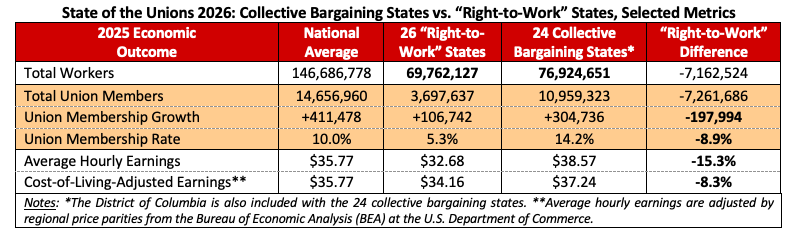
The report draws from U.S. Department of Labor data and concludes the United States added more than 411,000 union members last year, the largest one-year surge in membership since 2008. The report explores the labor movement both in terms of specific economic outcomes for workers and the intersection with state policy frameworks that enable workers to organize. In so-called “right-to-work” states, workers represented by unions are not required to pay for the services they receive, which reduces the resources labor would otherwise have available for bargaining wages, benefits, and organizing new members.
“The data consistently shows that workers earn higher wages when they are union members and work in states that protect collective bargaining rights,” said ILEPI Economist and study coauthor Frank Manzo IV. “More Americans are turning to unions as a bulwark against the rising cost of living. While this membership surge has occurred across the country, it has been most significant in states that protect collective bargaining rights—which added three times as many union members as so-called ‘right-to-work’ states.”
Researchers noted that the differences between “right-to-work” states and those that protect collective bargaining rights have grown wider over time. Since 2019, average hourly wages in states that protect collective bargaining rights have grown 3 percent faster than in “right-to-work” states.
“By raising the wage floor, collective bargaining benefits union and nonunion workers alike,” added University of Illinois at Urbana-Champaign professor and PMCR Director Robert Bruno. “The data makes clear that a rising tide lifts all boats.”
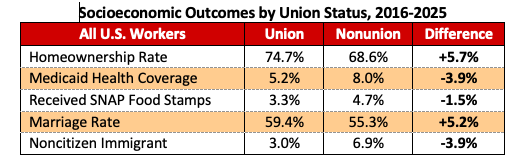
The report also details a variety of socioeconomic distinctions between union and nonunion workers, concluding that union members were less dependent on government assistance programs like Medicaid and food stamps but more likely to be homeowners, married, and U.S.-born citizens.
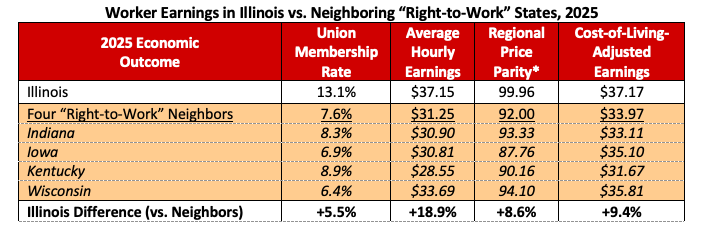
These trendlines were especially evident in Illinois. Voters codified the right to collective bargaining in Illinois’ constitution in 2022. Last year, Illinois added 24,000 new union members, reaching its highest union membership level since 2019 while organizing more new members since 2022 than in the previous seven years combined. Overall, the report found the share of Illinois workers who are unionized (13 percent) is higher than for the nation as a whole (10 percent), and its workers earn 9 percent higher wages than their neighbors in “right-to-work” states—Indiana, Iowa, Kentucky and Wisconsin—even after adjusting for cost of living differences.
“With elevated prices from the pump to the checkout counter, public opinion surveys consistently show historic bipartisan support for unions and other institutions that promote job quality,” Manzo added. “The real-world economic data reveals that these sentiments are well-founded because workers in states that support collective bargaining rights are better able to keep pace with rising costs.”
Nationally, in Illinois, and across the Chicago metropolitan region, public sector workers remain the most heavily unionized, including half of public sector workers in Illinois. More than 20% of military veterans are union members, as are nearly one-in-five Black workers. Union membership rates in Illinois exceed the national average across the board, including by age, gender, race and ethnicity, veteran status, education, industry, and occupation.
“While the growth reflected in this report is an important development, the labor movement still faces persistent challenges this Labor Day and beyond,” Bruno concluded. “To better align with voter preferences, policymakers could consider repealing ‘right-to-work’ laws and other policies that have weakened unions. The data conclusively shows these measures have only proven to depress wages for working families struggling with rising costs and to create additional welfare dependence paid for by taxpayers.”
The Illinois Economic Policy Institute (ILEPI) is a nonprofit, nonpartisan research organization founded in 2013 to deliver actionable research and expert analysis on public policy issues impacting businesses, working families, and taxpayers.
The Project for Middle Class Renewal (PMCR) at the University of Illinois at Urbana-Champaign investigates working conditions in today's economy to elevate public discourse aimed at reducing poverty, creating more stable forms of employment, and promoting middle-class jobs.
Todd Stenhouse
Illinois Economic Policy Institute
toddstenhouse@gmail.com
Legal Disclaimer:
EIN Presswire provides this news content "as is" without warranty of any kind. We do not accept any responsibility or liability for the accuracy, content, images, videos, licenses, completeness, legality, or reliability of the information contained in this article. If you have any complaints or copyright issues related to this article, kindly contact the author above.
