

Plastic Recycling Market at 7.75% CAGR to Grow from USD 83.20 Billion in 2026 to USD 162.88 Billion by 2035
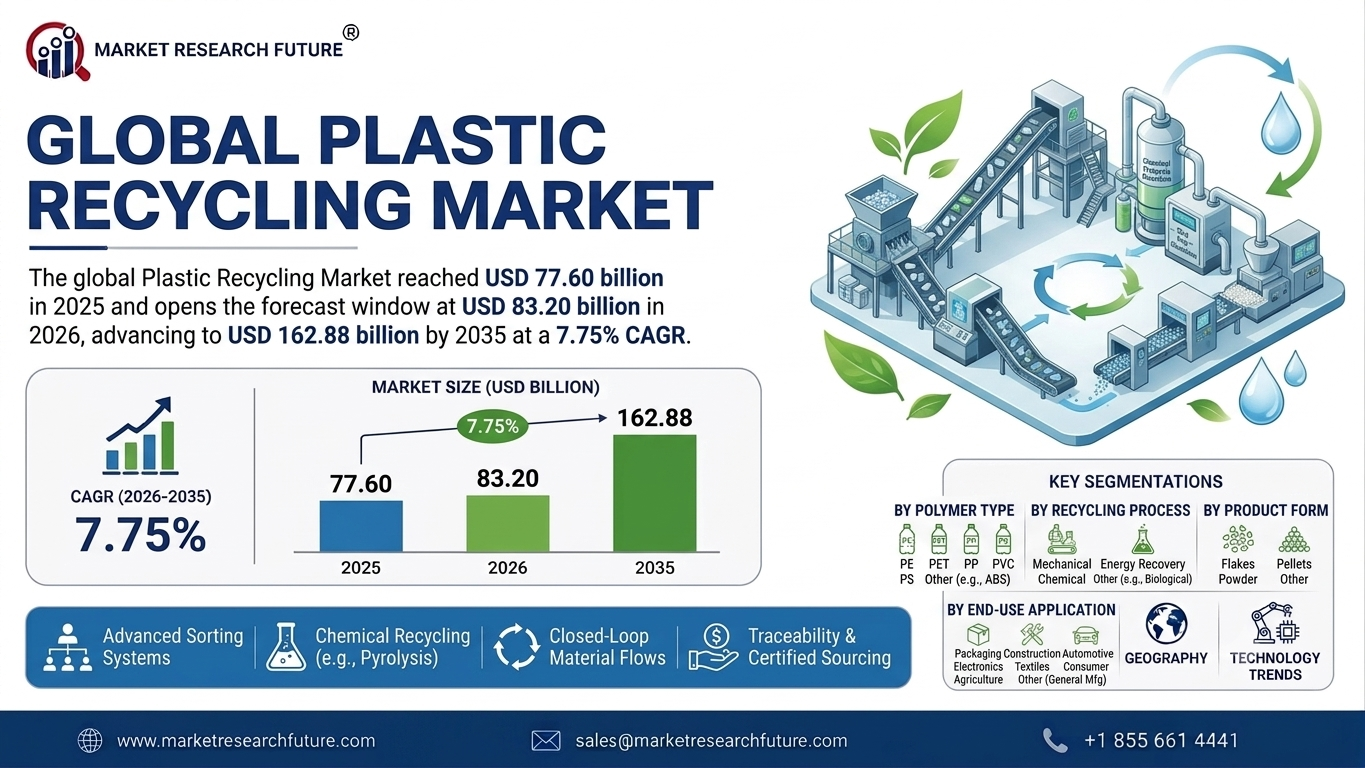
Plastic Recycling Market (2026 - 2035)
Asia-Pacific led with a 45.3% share in 2025.
WA, UNITED STATES, September 7, 2026 /EINPresswire.com/ -- The global Plastic Recycling Market is entering a major expansion phase as governments, manufacturers, packaging companies, and consumers increasingly prioritize circular material flows. According to the latest Market Research Future analysis, the market reached USD 77.60 billion in 2025 and is projected to grow from USD 83.20 billion in 2026 to USD 162.88 billion by 2035, registering a 7.75% CAGR during 2026–2035. Regulatory requirements, recycled-content mandates, advances in recycling technologies, and growing demand for post-consumer recycled materials are reshaping the global plastics value chain.The market is evolving beyond traditional collection and mechanical recycling. Chemical and advanced recycling technologies, digital traceability, extended producer responsibility programs, and long-term supply contracts are becoming increasingly important to secure reliable feedstock and meet quality requirements.
Plastic Recycling Market Growth Drivers
One of the strongest growth drivers is the increasing regulatory pressure to reduce plastic waste and increase recycled content. Regulations are transforming recycled plastics from a voluntary sustainability option into a strategic procurement requirement for packaging manufacturers and consumer brands.
The European Union's packaging regulations are particularly influential, establishing minimum recycled-content requirements for packaging. These policies are encouraging converters and brand owners to secure long-term supplies of certified recycled materials. At the same time, extended producer responsibility programs are expanding across Asia-Pacific markets, increasing investment in collection, sorting, and recycling infrastructure.
Another important driver is the growing commitment of major brands to incorporate post-consumer recycled content into packaging and products. This is creating more predictable demand for recycled polymers and encouraging recyclers to invest in new processing capacity.
Technological Advancements Transform Recycling
Technology is changing the economics and capabilities of the Plastic Recycling Market. Mechanical recycling continues to account for the majority of market activity, but advanced recycling technologies are expanding the range of plastic waste that can be recovered.
Mechanical recycling represented 75.8% of processed volume value in 2025, supported by an established infrastructure of washing, sorting, extrusion, and pelletizing facilities. However, chemical and advanced recycling is projected to grow at a 9.32% CAGR through 2035, making it one of the fastest-growing areas of the industry.
Advanced technologies such as pyrolysis, depolymerization, dissolution, and enzymatic recycling can address feedstocks that are difficult to process through conventional mechanical systems. Colored, multilayer, contaminated, and textile-derived plastics represent important opportunities for these technologies.
The commercialization of depolymerization is particularly significant because it can help produce recycled polymers with specifications closer to virgin materials, supporting higher-value applications.
Download Report Sample Copy with TOC: https://www.marketresearchfuture.com/sample_request/2859
Packaging Remains the Largest Application
Packaging is expected to remain the leading application for recycled plastics. The segment accounted for 41.5% of Plastic Recycling Market demand in 2025, supported by recycled-content mandates and commitments from consumer brands.
PET bottles, flexible packaging, rigid containers, trays, and other packaging formats provide substantial feedstock for recycling facilities. Increasing demand for recycled PET and other food-contact materials is also encouraging investment in high-purity sorting and decontamination systems.
The transition toward mono-material packaging is another important development. Packaging designs that are easier to sort and recycle can improve recovery yields while reducing contamination throughout the recycling process.
Automotive Recycling Creates New Demand
Automotive is emerging as the fastest-growing end-use application, with a projected 10.94% CAGR through 2035. Increasing focus on vehicle circularity and recycled content is creating new opportunities for recycled polypropylene and engineering plastics.
Recycled plastics are increasingly relevant for interior components, wheel-arch liners, underbody shields, housings, and other vehicle applications. Automotive manufacturers require consistent mechanical properties, color, odor, and material specifications, which is encouraging recyclers to develop higher-quality engineering-grade recycled polymers.
The growing emphasis on end-of-life vehicle recycling could further strengthen demand for certified recycled material.
Polymer Type Trends in the Plastic Recycling Market
By polymer type, polyethylene accounted for 31.2% of market value in 2025, supported by rigid containers and film reclamation. Polypropylene represented 18.4%, reflecting its extensive use in packaging and automotive components.
PET is also a major material in the market, with a 2025 value of USD 19.09 billion, driven by bottle-to-bottle recycling and food-contact applications.
Meanwhile, the Other Plastics category, including ABS, PC, and PA, is projected to grow at a 9.78% CAGR through 2035. These engineering plastics offer significant potential in automotive, electronics, and industrial applications where recycled materials must meet demanding performance specifications.
Product Forms and Recycled Resin Demand
Flakes represented 71.1% of output value in 2025, making them the dominant product form. They are widely used in bottle-to-bottle conversion, thermoforming, and other recycling applications.
Pellets and granules are expected to experience faster expansion, with an 8.44% CAGR through 2035. Their growth is linked to closed-loop applications in food-contact packaging, automotive components, and injection molding.
As recycled plastic quality improves, demand is expected to shift toward standardized, application-specific recycled resin grades rather than lower-value recovered material.
Buy Now: https://www.marketresearchfuture.com/checkout?currency=one_user-USD&report_id=2859
Regional Outlook
Asia-Pacific
Asia-Pacific was the largest regional market, accounting for 45.3% of global value in 2025, and is also the fastest-growing region with an 8.62% CAGR through 2035.
China, India, Japan, South Korea, and ASEAN countries are important contributors to regional growth. China's expansion of municipal waste sorting has improved the availability of documented feedstock, while extended producer responsibility programs are expanding across Southeast Asia.
India is also becoming an important growth market as recycled PET gains acceptance in food-contact packaging and domestic recycling infrastructure expands. The country is projected to record a 9.84% CAGR, according to the current MRFR report.
Europe
Europe accounted for 24.8% of the global market in 2025, with regulatory requirements representing one of its strongest growth factors. The region generated approximately USD 19.24 billion in 2025.
Germany benefits from established deposit-return infrastructure, while the United Kingdom, France, Italy, Spain, and other European markets are investing in collection, recycling, and packaging circularity.
Europe's strong regulatory environment provides recyclers with comparatively predictable demand, particularly for certified food-grade and packaging-grade recycled polymers.
North America
North America generated approximately USD 15.60 billion in 2025. The region's growth is increasingly focused on improving feedstock quality, upgrading sorting infrastructure, and expanding bottle-to-bottle recycling capacity.
The United States represents the largest portion of regional demand, supported by infrastructure funding and state-level recycled-content requirements. However, contamination and inconsistent bale quality remain important constraints on capacity utilization.
Middle East & Africa
The Middle East & Africa Plastic Recycling Market is projected to expand at a 7.82% CAGR through 2035. Petrochemical integration, municipal sorting infrastructure, and emerging circular-economy initiatives are supporting investment.
The Middle East has an additional opportunity to integrate recycling operations with existing polymer and petrochemical infrastructure, while African markets are gradually developing collection systems in major urban centers.
Key Challenges Facing the Market
Despite strong growth prospects, the Plastic Recycling Market faces several structural challenges. Virgin resin price volatility can reduce the competitiveness of recycled polymers when virgin materials become cheaper. This can pressure recycler margins and make investment decisions more difficult.
Feedstock contamination is another major challenge. Inconsistent collection quality increases washing and processing requirements and reduces the yield of high-quality recycled resin.
Advanced recycling facilities also require significant capital investment. Chemical conversion plants can have substantially higher capital intensity than conventional mechanical recycling facilities, while permitting and technology-performance risks can extend project timelines.
Food-contact applications create additional certification requirements, limiting entry into some high-value markets to companies with sufficient technical and financial resources.
Opportunities in Plastic Recycling
The expansion of textile-to-polyester recycling represents a major opportunity. Textile waste often contains complex fiber blends that are difficult to recycle mechanically, creating an addressable market for depolymerization and other advanced technologies.
Emerging markets also offer significant opportunities because plastic waste generation is increasing faster than formal recycling infrastructure in many developing economies. Investments in collection, sorting, washing, compounding, and traceability can therefore unlock substantial new capacity.
Digital traceability is another emerging opportunity. Batch-level tracking can connect recovered plastic with its source and processing history, helping manufacturers substantiate recycled-content claims and meet increasingly stringent regulatory requirements.
Long-term offtake contracts are also changing project economics. Recycling facilities with secured buyers and indexed pricing can reduce exposure to fluctuations in virgin resin prices and improve financing prospects.
Report Summary: https://www.marketresearchfuture.com/reports/plastic-recycling-market-2859
Competitive Landscape
The Plastic Recycling Market is competitive and includes global waste-management companies, polymer producers, recyclers, and specialized technology providers. Major companies identified by MRFR include Veolia Environnement SA, Indorama Ventures PCL, SUEZ SA, LyondellBasell Industries N.V., Alpek S.A.B. de C.V., and Berry Global Group, Inc.
Other companies participating in the broader competitive environment include SABIC, Republic Services, Biffa, MBA Polymers, Loop Industries, and Carbios.
Competitive strategies increasingly focus on securing feedstock, expanding recycling capacity, developing advanced processing technologies, establishing long-term customer contracts, and improving traceability.
Future Outlook
The future of the Plastic Recycling Market will increasingly depend on feedstock security, processing quality, regulatory compliance, and technology commercialization.
Through 2030, competition is expected to shift from simply building recycling capacity toward securing reliable streams of suitable plastic waste. Recyclers are increasingly exploring long-term municipal supply agreements and partnerships with materials recovery facilities to control upstream feedstock availability.
Advanced recycling is also expected to become more competitive as plants move from first-generation demonstrations toward larger commercial facilities. Improvements in engineering, operational experience, and scale could reduce conversion costs and make advanced technologies more attractive for difficult-to-recycle plastics.
At the same time, digital compliance and product traceability will become increasingly important. Buyers in regulated markets will require stronger evidence of recycled content, material provenance, and processing history.
Related Report
Recycled Plastic Market https://www.marketresearchfuture.com/reports/recycled-plastic-market-11993
engineering plastic recycling market https://www.marketresearchfuture.com/reports/engineering-plastic-recycling-market-41941
fiber reinforced plastic recycling market https://www.marketresearchfuture.com/reports/fiber-reinforced-plastic-recycling-market-32264
plastic recycling equipment market https://www.marketresearchfuture.com/reports/plastic-recycling-equipment-market-40202
Microplastic Recycling Market https://www.marketresearchfuture.com/reports/microplastic-recycling-market-12472
Market Research Future
Market Research Future
+1 855-661-4441
email us here
Legal Disclaimer:
EIN Presswire provides this news content "as is" without warranty of any kind. We do not accept any responsibility or liability for the accuracy, content, images, videos, licenses, completeness, legality, or reliability of the information contained in this article. If you have any complaints or copyright issues related to this article, kindly contact the author above.
